
Everything Sounds The Same Here
When did Substack start feeling like a millennial coffee shop?

Substack has been getting on my nerves lately… but maybe I’m just woman’ing the platform? She’s finally having her moment as the slow media alternative to Instagram’s and TikTok’s utter soullessness, and logically the next step is they wanna see you fall-fall-fall.1
I’m just tired of seeing essay after essay regurgitating why phones are bad and we need to start connecting more. Why celebrity culture is rotted and Taylor Swift is a mean girl. Why Everyone Wants a Village, But No One Want To Be a Villager. Girl, if your cottagecore village fantasy was actualized, there wouldn’t be any Substack writers. Do you know how to use a farming scythe?
I’ve been hit over the head with the concept of community so many times that it’s now emblazoned against the back of my eyelids. Many essays can be summed up as: BE A GOOD COMMUNITY MEMBER OR PERISH IN THE FLAMES OF YOUR LONELINESS…
I get it, we all spent the last decade being antisocial, chronically online freaks. My pandemic routine was diabolical – every night, locked away in my childhood home, I downed three White Claws, posted 10 TikToks, and took more vape hits than breaths. I treated my body like a slot machine in a desperate attempt to replicate the dopamine rush of an in-person conversation. That obviously wasn’t sustainable.
But that naked depravity resulted in an equal-and-opposite reaction: The pendulum peak of Touch Grass philosophy. Countless essays with titles that start with “you…” what you need to do differently, why you feel empty inside; constant badgering like unsolicited advice from an almond mom.
Underneath it all is a universal message: Why you need to start living. Sometimes authentically gets stapled to the end. Each 1,000 word missive promises to finally solve everything and offer a buoy out of our frenetic and dystopian existence.
Substack encourages us to write about authenticity, while manufacturing it into a clean narrative story arc. How am I supposed to explain my scars when many of them are still hemorrhaging? When resolution would be a lie? When my authentic self is mangled, selfish, and not pretty for print?
The Notes feed is even worse, oozing with Hallmark quotes and circle-jerking over the beauty of a slow, reflective morning. It has the unmistakable energy of those millennial, vaguely religious, Live Laugh Love coffee shops that play The Lumineers and Mumford and Sons.
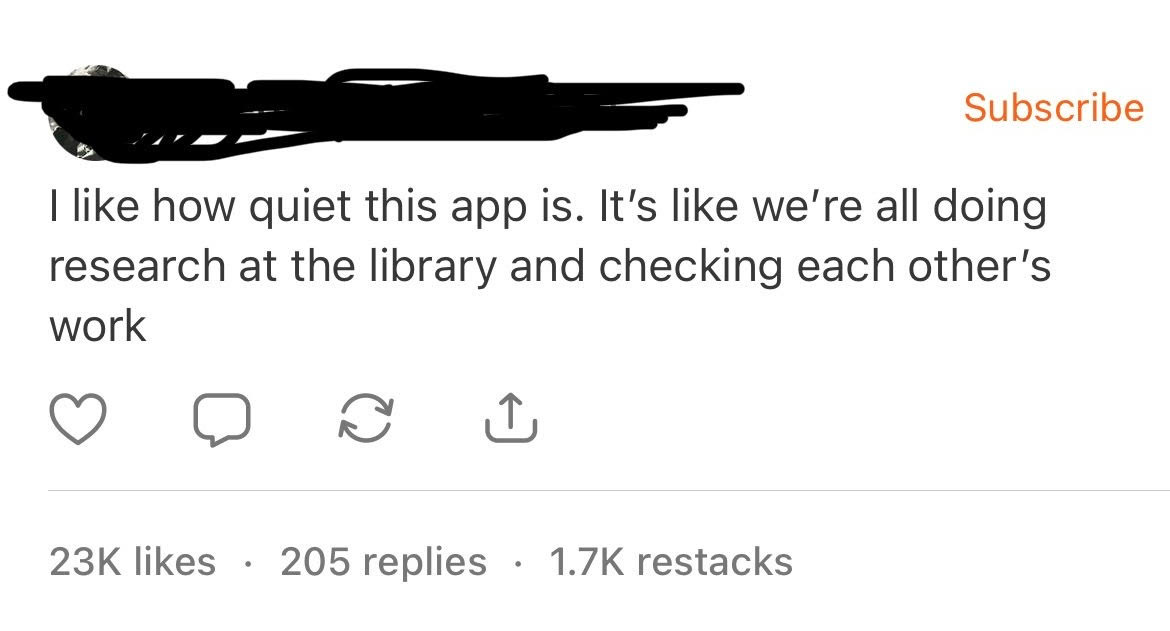
And I’ll admit, a lot of this is projection. I’m critiquing the platform, but really I’m critiquing what it’s turning me into. There’s a tiny, evil, gay talent manager in my head screaming that anything that doesn’t go viral is a flop, and anything that does is my magnum opus. The pieces that float in the middle are a threat… Girl you’re losing your touch.
Frankly, it sucked the fun out of writing. I hate every piece by the time I’m finished. I know my flaws intimately, spending hours hyper analyzing each cliche and cheap argument while high in bed; creating multiple personalities so I can critique my work from the angle of everyone I’ve ever loved and respected.
Once I told my friend she was beautiful, and she said that no matter how many people tell her that, it means nothing. I thought she was being vain. I understand now.
For all my bitching about how predictable, overengineered, and prescriptive personal essays have become, I find myself following those same scripts:
Theme: Something specific but universal. The “unsaid” thing everyone is thinking about.
Structure: Start with an anecdote, expand it into a diagnosis, then tether it back to your personal experience, but don’t linger too long or you’ll lose everyone’s peanut-brain attention span.
Viral Factor: Sprinkle in restackable quotes, questions like What am I – if not online? and reheated women are taught to shrink ourselves nachos.
Tone: Smart casual – poignant and refined, but ultimately unthreatening. “Hot takes” that are universally held among Mamdani voters.
Contemporary litslop is an AI wet dream, filled with elaborate metaphors conveying intuitive conclusions. It’s not just bad writing — it’s the quiet death of the personal essay. As AI floods every creative field, this kind of storytelling will only become more common. The upside is that it places an even higher premium on original, oddball, personality-heavy voices.
I struggled to name what was missing, until I came across GQ Site Director and Embedded founder, Nick Catucci’s interview in Human Pursuits. He says the best writers and editors have a sense of mischief — work that isn’t a flat surface for readers to slide down, but something that provokes them, in good faith.
I crave writing that smiles with its canines exposed. Writing that isn’t met solely with comments like THANK YOU FOR SAYING THIS. I loved Kieran Press-Reynold’s interview with Bassvictim because it trusted the reader with something messy, unguarded, and emotionally volatile — just like their music. Anything less would have been sacrilege.
Most of my viral essays have hate comments. That used to horrify me — I thought disagreement meant I was wrong (#FawnResponse.)
But the writing I love most doesn’t speak to me so much as it implicates me. It exposes parts of myself I thought I’d hidden well. Dennis Cooper, one of my favorite authors, writes books that make me physically ill. Mark Twain and John Steinbeck write from the perspective of an unruly kid, not his well-meaning guidance counselor, because mischief needs a body. Kids poke sore spots and scrape dirt underneath their fingernails.
I sometimes wonder what we lost when we democratized writing. Everything seemingly has tenderized for mass appeal. But I don’t think we’re facing a lack of talent so much as a crisis of taste, a symptom of platforms designed to nurse our most base instincts. Content creators have replaced journalists. Prestige television has flattened into Netflix originals. The Grammys are streaming on YouTube. MrBeast is crowned a marketing genius.
When we doomscroll, order Uber Eats, and outsource questions like what should I read next? or how do I respond to this text? to ChatGPT, we’re choosing convenience, comfort, and legibility. The serendipity and strangeness of life gets skinned smooth. Our lives have lost friction.
It makes sense that our writing has, too.
Sympathy is a knife - Charli xcx is a bible of sorts
I think you’ve hit on something key, Chrissy. Substack has become its own performative form of community, with a sanitized, reductive set of safe topics and cliched phrases that establish membership in that community of thought. This was done as a backlash to the rage-baiting and trolling of other platforms, which is understandable, but has become its form of ideological prison. Your writing is remarkable in that it refuses to conform to this orthodoxy and offers a form of expression that feels radically free and personal. I’m really looking forward to what you write in 2026.
If it’s any consolation, you are one of the strongest voices I read here in terms of having a unique perspective and tone, so, for the time being, I wouldn’t include your work in that great “homogenization.”
On another note, I think if every Substack essayist was forbidden from using words like “gentle,” “tender,” “ache,” “soft,” etc etc maybe that would help a little? Maybe we’re frustrated with different writers.
My central issue with how things are going is how all-or-nothing some of these essays can be; how a new album can be “the end of the American straight woman” or some random tweet signals “the downfall of the American community” fill in the blank as you must. Essays were never meant to be so all-encompassing. The best stay small, in a particular, and often peculiar moment, else there wouldn’t be something worth saying. And something can be worth saying if it doesn’t get tacked to something so huge. It’s a try, not a total remedy. Right?