
Adderall Nation
A transmission from ADHQ

All rise, the secret society of tweakalicious queens and finance chads – an unholy but necessary alliance. Yes, I’m looking at you, with your chapped lips and shifty eyes. Are you locked in? Brainmogging these thoughtcels? Making that pivot table your bitch? Do you love this shit? Are you high right now? Do you ever get nervous? Are you stimulated?
Maximize that shareholder value like the productivity slut you are. Better move faster – AI is nipping at your heels. I wouldn’t want to have to press the button….
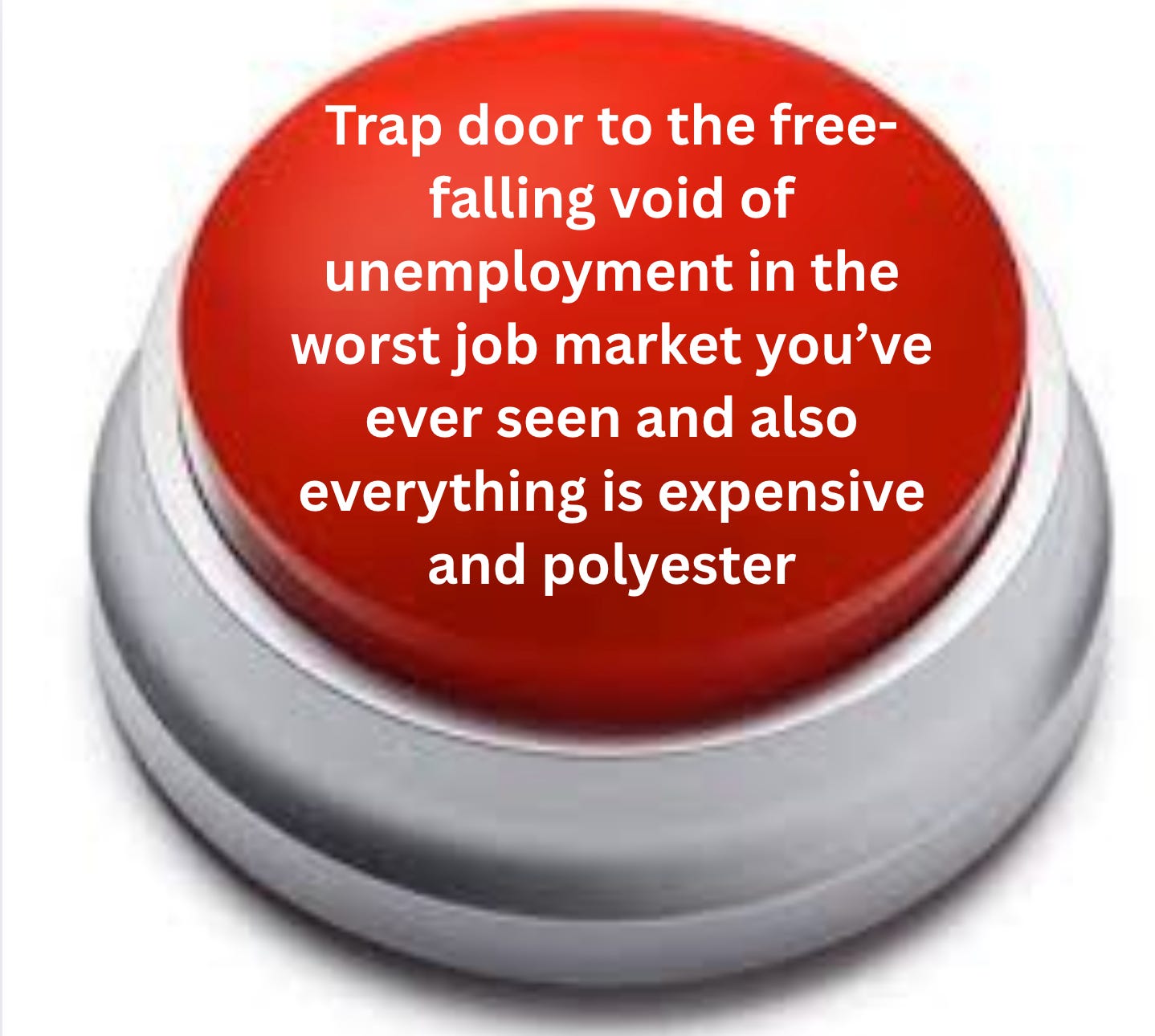
Excuse me.. I got a little carried away.. just wanted to grease my good little cog. Don’t worry, management is installing state-of-the-art Zyn dispensers to reward you with a nicotine pellet for every sale.
You see, I’ve recently been promoted to Assistant to the Regional Mechanism for my high performance and can-do attitude. It’s my job to maintain morale and ensure that the numbers on the graph keep going up and up and up. Yes, those numbers – the ones produced through complex financial gamesmanship with little bearing on whether you can afford rent. EBT is not a KPI, sorry.
But I have a secret. I’m a rogue agent, transmitting this message live from ADHQ.
Let me catch you up to speed (no pun intended.) I’m patient zero for attention deficiency – aloof, careless, absent-minded. I’m the “Type B friend.” My Apple ID password changes every time I need to log in. I don’t have a social calendar, exclusively surviving on text check-ins, Partiful invites, and prayer.
Ovens fear me, my no-show fees keep the lights on at half the doctors offices in Manhattan. God bless my therapist, the number of times she has seen me log on 20 minutes late because I was in the middle of at-home Pilates when I remembered our appointment. Luckily, I pay her to tell me I’m valid.
But I also have that weird divergent intelligence common among the neurospicy, as the blue-haired alphabet mafia likes to say. My friend Vanessa told me that I’m the “smartest and dumbest person she knows.” Like, yes, I’m erudite and articulate and cerebral and — wait, fuck fuck fuck. Has anyone seen my keys? I think I left them in the Uber. Wait sorry guys can someone call him? Fuck, he’s not answering. Why isn’t he answering? Probably because it’s 6 AM and he has a family. Fuck my life, oh my god.
My brilliance is constantly cockblocked by my listlessness. I did well in school — good grades, a full scholarship to study graduate school in Madrid — but every achievement was produced through last-minute neurotic fever dreams, pulling all-nighters powered by white Monster, Adderall, and vending machine Twinkies.
Since starting this newsletter, I’ve been asked how I have the time and motivation for a consistent writing practice. Part of me wants to lie, pretend I’m some stoic, disciplined monk capable of grinding 24/7 through sheer will. But instead, I tell the truth — Girl, I be tweaking.
Maybe it’s because I’m certified Attention Deficit™, but I genuinely don’t know how anyone stays on the hamster wheel without stimulants: finding and keeping work, exercising regularly, maintaining a social life, cooking nutritious meals, tending to hobbies and extracurriculars, all without being a cranky, miserable bitch to everyone around you. This is to say nothing of the daily horrors of bill payment and appointment scheduling. We clowned millennials for complaining about “adulting,” but they lowkey ate. This shit is HARD!!
So we’ve been sold this tiny orange candy as a cure to modern malaise. Adderall is the fluoridated water of corporatized life, powering a hustle culture that demands productivity at all costs.
ADHD diagnoses are on the rise, as are its various treatments and villainous-sounding generics: dextroamphetamine (Adderall), lisdexamfetamine (Vyvanse), methylphenidate (Concerta – a beautiful girl’s name), which isn’t to be confused with dexmethylphenidate (Focalin.) But this is all hypothetical, given the national shortage due to the FDA’s bureaucratic bullshit. As of late, my life’s soundtrack is guitar-solo hold music while my health insurance’s “““patient advocate””” searches for a solution, and I try not to Karen out.
Mainstream popularity has perverted the diagnosis and treatment in the public’s eye. No one thinks ADHD is real, yet somehow, everyone has it – part of the trifecta of vague, universalizing identities, alongside autism and being nonbinary. The enigma has drawn sharp battle lines between the stimulant truthers and the apostates. The clean and the soiled. The hardknocks and the grifters. Raw-dogs and cooked-cathinones.
I find that many people have little patience for executive dysfunction, especially in the current “the price of community is inconvenience” zeitgeist, as the pendulum has swung away from protect-your-peace isolationism and toward “you’re a bitch, and that’s why we lack community.” Laziness, selfishness, unreliability, and apparently now bitchiness, are often used to describe classic ADHD symptoms. And I get it, sometimes it literally is just laziness, selfishness, and unreliability. Clock it! Like most binaries, there’s kernels of truth hidden under the layers of shit-slinging moralism.
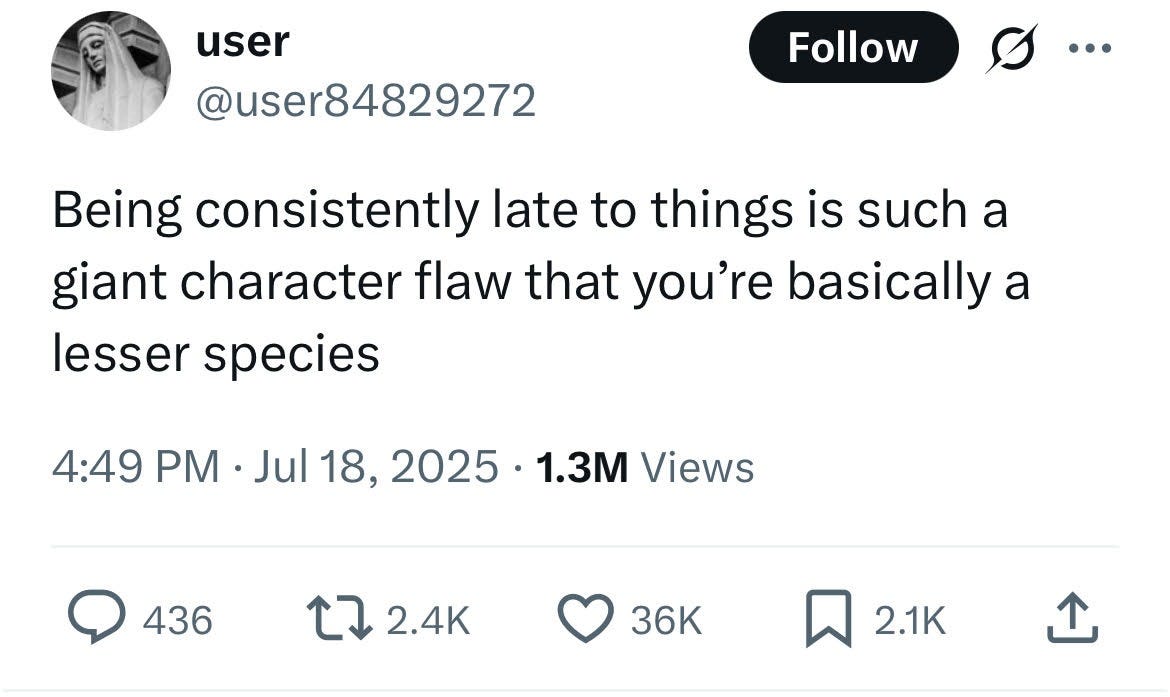
But the unsexy truth is that ADHD cripples all aspects of my life, from the extreme to the mundane: I can’t take the first step toward pursuing a creative passion, and I also can’t donate the clothes collecting dust in the corner of my room. I definitely cannot get to your 9 PM pregame at 9 PM. Like sleep paralysis, I’m fully conscious but can’t move a muscle.
So yeah, ADHD has become a bit of an eye-roll, something for white people to cling to as an oppressive identity. And to be fair, some of us are… a little insufferable. Do not talk about taking Adderall illicitly in front of the diagnosis police unless you’re prepared for a ten-minute lecture about how “it’s sooooo different for people with ADHD,” how they “can take a nap on it.” Girl, whatever. “Omg, is this how normal people feel all the time??” No, you’re high on amphetamines. Sorry, but it’s not fucking antibiotics. This isn’t an Adderall hit piece, its medically necessary for millions of people — including myself. But we can acknowledge that and be honest about it’s effects at the same time.
I understand why they’re so protective – there’s an urgent need to legitimize the diagnosis and dispel the notion that we’re just slothful babies who need shortcuts. Because admitting you take stimulants kinda feels like admitting to using the motherlode cheat code on Sims. Suddenly all of my accomplishments are in question, or at least, in context.
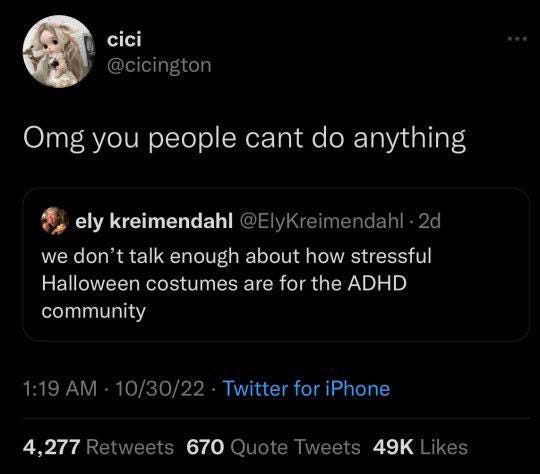
All the you people can’t do anything tweets, time blindness discourse (she was valid, idc), and hate toward Sock leave little room for nuance. Two things can be true — you can be a self-aware addict. Yes, I need Adderall to function. Yes, the drug rules my life and the comedown makes me want to kill myself. It’s the duality, luv…
On days I don’t take my medication, I jut around like a short-circuited Roomba – doubling-back, constantly redirecting, needing a little kick in the butt and constant supervision to complete a task. My roommate sometimes half-jokingly asks me to take my Adderall because I’m lowkey annoying otherwise. I’ll storm into her room, jump on her bed and circle around like a dog, start telling a story about a weird date I went on before getting distracted by my reflection in her mirror and running away because I realized I need to pee, somehow leaving my socks in her room. Unfortunately, it’s not socially acceptable to be a 27-year-old toddler.
It feels like I’m both Adam Scott in Severance and Demi Moore in The Substance. In the daytime, with prescription dopamine flowing through my bloodstream, I am alert, clear-headed, productive, and focused. I can sit through meetings without checking my phone, consistently meet deadlines, follow through on my word, take an idea from Point A to Point B. I can cook elaborate meals and organize my skincare by actives and humectants. I can write this essay. I am the person I hope people see me as.
But then comes the Crash - Charli xcx. Stimulants are a time-bomb, how much can I get done before I start to feel like shit? When the comedown hits, it’s spiritually raining and I don’t have an umbrella — hopeless, pissed off, cursing God and anyone who crosses my path. In this way, my social life is still crippled. I’m wary of activities during the week because my evening mood is so unpredictable. Sometimes things are okay, other days I have no choice but to lobotomize myself with video games and doomscrolling.
Funny enough, I scribbled the beginning of this manifesto at 10 PM on a day I didn’t take my medication. On those days, I’m hit with a second wind and come alive at night. I wish I had the luxury to be pushed and pulled by my creativity’s winds. But mostly, I exist from 9 AM - 6 PM, after which I enter purgatory until the next day, when I take another one of those sweet Tic Tacs.
I – I’m losing signal… they’re on to me. The alarms are blaring; everything’s fracturing into static. I wish I had a solution, but all I can offer is the diagnosis – our synchronized twitch to the hum of the attention economy, white-knuckling through inboxes in a desperate attempt to build a life, on paper, worth admiring.
And somehow, this quiet schism between who I am and who I perform has unfolded without even a whisper. I take my medication like I breathe air. Not because I want to, but because stopping would mean stillness. And stillness, these days, feels indistinguishable from death.
END TRANSMISSION
Okay so I'm studying to be a therapist, and none of this is gonna contradict anything you said which is all absolutely correct, but I think I can actually square the circle here maybe? (Sorry for the wall of text)
The crucial thing to understand imo is that the diagnostic criteria for ADHD, as with most mental conditions, is that it becomes diagnosable *at the point where the symptoms begin to interfere substantially with your ability to function in your daily life*. I think we'd all agree that people naturally fall somewhere along the bell curve of some vague "attentional capacity/executive function" axis. So, I'm simplifying here, but if the amount of attentional capacity/executive function you need to function in your daily life is X, anyone who falls below X on the bell curve could be diagnosed with ADHD.
But what happens when X goes up? What happens when all of society becomes organized such that more attentional capacity is required to function? What happens when, say, corporate culture goes from 8 hours in a cubicle with no interruptions to meetings scheduled every 30 minutes? What happens when half of everyone's attentional capacity is passively consumed by the glowing stimulation obelisk in their pocket? What happens when places where you'd passively meet people, make friends, and build community disappear and finding even basic social interaction requires an active deviation from your normal life? Well, when X goes up, more people on the bell curve are below X, so more people get diagnosed with ADHD. They're not fundamentally broken, nor are they necesarily being overdiagnosed. It just turns out that when you make it more attentionally demanding, and more demanding of executive function, to function in real life, more people understandably need additional support to function in real life.
So like... all of this is to say that I think both things are true. ADHD medication is not some magical substance that is uniquely effective for people with ADHD and has completely different effects for them than for everyone else. To paraphrase a very smart person, girl, they be tweaking. But also it is kinda true that ADHD medication can just give people who struggle with everyday life access to the kind of cognitive state that people who don't need it to function already have access to. Which is, of course, what you've already described. So my tiny addendum would be, the solution is probably not anything any of us is gonna do individually; it's probably just that we as a society need to make functioning without medication easier.
This made me giggle 🤭 But also, very relatable discourse. At this point, I have made a point to develop enough swagger about my diagnosis that people don’t tend to question me so much, and other neurospicy people tend to be in my main orbit so I don’t feel the need to overexplain myself.
What encouraged me to finally pursue medication to help was when my cousin told me (several times) that you don’t get a gold medal for suffering and not using medication doesn’t give you a moral high ground.